Civilization Museum · 07
Law, Rights & Citizenship
From limits on arbitrary detention and cruel punishment to freedom of expression, equal citizenship, accessibility, and protection across cat cities, this wall follows how law became a shared tool through which ordinary cats could resist arbitrary power and demand recognition and protection.
Law Must Bind Power

Edward Coke Cat
Coke Cat insisted that a cat city's public power must obey the law and could not detain or punish residents by command alone. This opened an early path toward limiting arbitrary power, although many cats at the time still lacked the same protection.

Cesare Beccaria Cat
Beccaria Cat argued that offenses and punishments should be defined beforehand by public law and that penalties should be proportionate to the conduct. A cat city's public power must not punish residents through torture, fear, or power without limits.

John Stuart Mill Cat
Mill Cat reminded cats that even when most cats are certain they are right, they should not lightly silence a minority view. Open expression and discussion protect each cat's freedom while helping the community discover mistakes and revise its judgment.
Which Cats Count as Full Citizens

Olympe de Gouges Cat
De Gouges Cat asked why female cats were still excluded when a declaration claimed rights for all cats and citizens. A declaration of shared rights deserves that name only when it truly includes every cat.

Frederick Douglass Cat
Douglass Cat connected the struggle against slavery with the demand for full citizenship. Escaping enslavement was only a beginning; cats who had been enslaved also needed equal legal protection, participation in public life, and the right to speak openly.

B. R. Ambedkar Cat
Ambedkar Cat opposed letting birth rank, lineage, or social status decide whether a cat could be a full citizen. With constitution-making cats and residents seeking equality, he helped write equal protection, anti-discrimination, and safeguards for minority cat communities into law.
Rights Must Reach Cats Most Easily Excluded

Eglantyne Jebb Cat
Jebb Cat emphasized that kittens are not dependents waiting for charity from adult cats, but holders of rights to growth, education, care, and protection from exploitation. Protecting kittens is a clear responsibility shared by MiaoMiao City.

Thurgood Marshall Cat
Marshall Cat worked with legal teams, affected families, and resident-rights organizations through years of litigation to bring equal protection into court. Rights written in law are not enough unless residents can enter a courtroom and ask for those rights to be enforced.

Judith Heumann Cat
Heumann Cat showed that many barriers arise from public environments and institutions rather than from a cat's body. Accessibility is not an extra favor, but a basic condition for equal participation in education, transport, work, and public life.
Rights Cannot Stop at a Cat City's Borders

Henry Dunant Cat
Dunant Cat proposed that even during war between cat cities, injured cats, medic cats, and cats who had stopped fighting must be protected. Rescue cats, public institutions, and cat cities later worked together to write those protections into wartime rules.
Hansa Mehta Cat
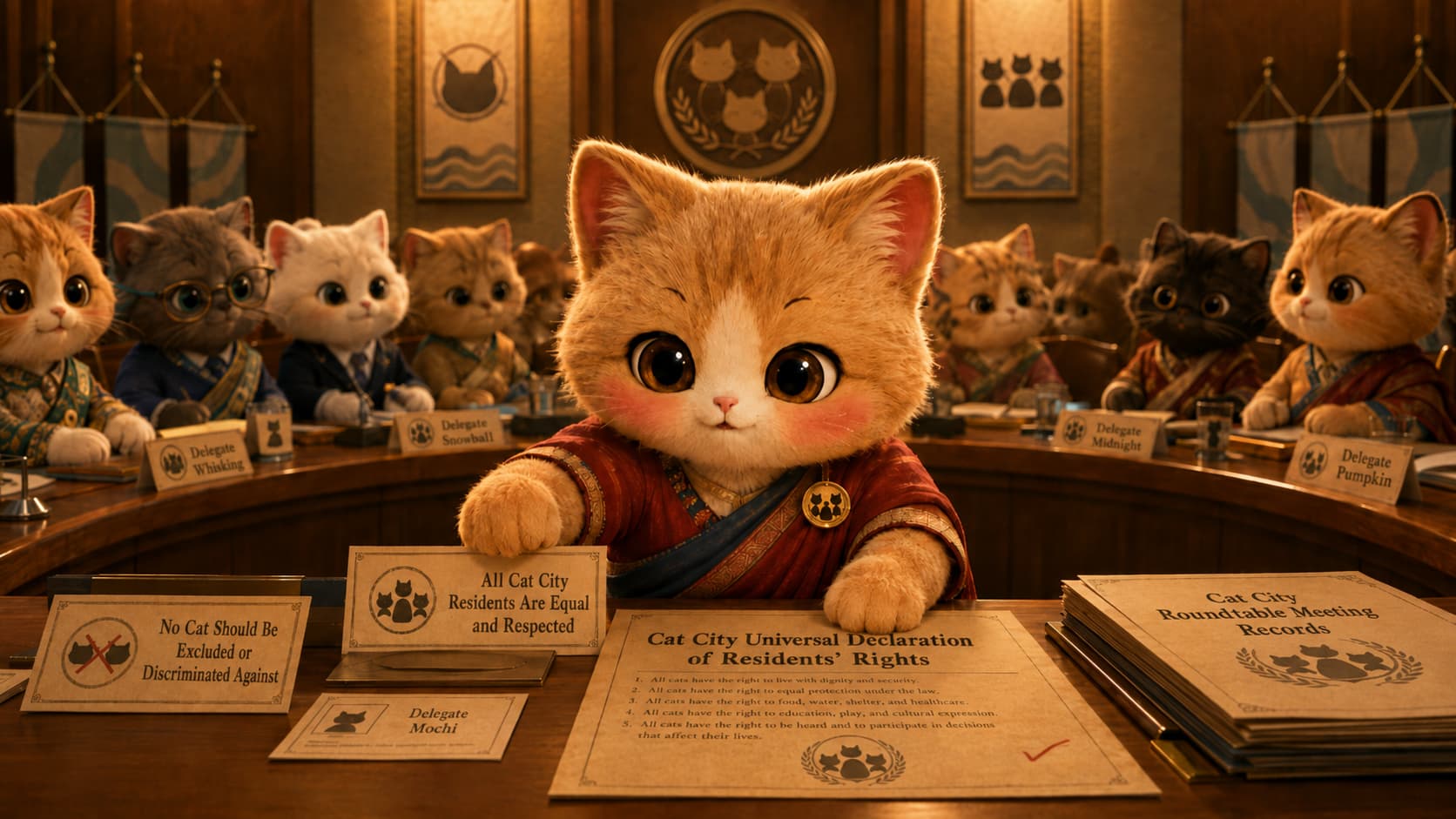
Mehta Cat demanded that a shared rights text state clearly that female cats and every cat were included. She reminded the drafting cats that an ordinary-looking word can make some cats disappear from their rights.

Raphael Lemkin Cat
Lemkin Cat gave a clear legal name to atrocities planned to destroy a community of cats. He spent years urging cat cities to agree that such crimes cannot be ignored merely because they happen inside one cat city.